1

Your cart is empty.

The UK’s leading professional architecture magazine


AJ 20.06.2026: AJ100

AJ 20.06.2026: AJ100

This month’s issue presents everything you need to know about the UK’s largest architecture practices, including fee and practice data.

The findings reveal a mixed picture. The total number of architects employed has reached an all-time high of 7,729, yet growth is tapering, fee income has plateaued and the proportion of architectural assistants continues to fall. More positively, diversity continues to improve and AI adoption has surged across the cohort. 

We also reveal the winners of the 2026 AJ100 Awards. Find out why Donald Insall Associates has been crowned Practice of the Year for its future-facing approach to heritage-led conservation, and discover who is leading the way on sustainability, mentoring, communication and community impact.

The Contribution to the Profession award goes to Victoria Thornton, founder of the Open House programme, recognised for her tireless promotion of free access to architecture and championing of young people’s voices. We also celebrate emerging talent in our New Talent awards for Part 1, Part 2 and newly qualified architects.

Opinion this month comes from Marcus Adams of JTP, who makes a plea to practices to keep employing Part 1 architectural assistants at a time when rising wages, AI and economic pressures are making entry-level roles harder to sustain.

In Culture, Rob Wilson reviews Isaac Julien’s film installation All That Changes You. Metamorphosis at London’s Cosmic House, and Luke Neve reviews John Grindrod’s new book on LGBTQ+ lives in Britain’s suburbs.

Rounding out the issue are the Secret Architect on the perils of dating as an architect, sketches by Sam Sedgewick of GT3 Architects, David Grandorge’s photograph selection and a competitions compilation.

£16.00

AJ 21.05.26: Manchester

AJ 21.05.26: Manchester

Our cover star this month is Andy Burnham – a man making local and national waves. Manchester is a city on the up, literally, and in his role as mayor Burnham is a major driving force behind that. The AJ spoke to him about how the city has become a model for growth and devolution.

There are three building studies which showcase Manchester’s style and spirit: Sheppard Robson’s deep retrofit of a city-centre office; Buttress Architects’ affordable, sustainable housing development in Ancoats; and Project 3 Architects’ flexible workspaces in retrofitted Victorian market halls.

While Manchester is set to become Europe’s fourth tallest city, in its next phase of development it will be spreading outwards with new and greener schemes. In the issue you can read a feature about this, which reveals a concerted effort to increase social and affordable housing over the next decade.

There are also some striking ‘then and now’ pictures of the cityscape from Euan Kellie, which show how far it has developed in just a few decades. Then we round up the best recently completed projects in the city, along with a map showing where all the upcoming developments are located.

Opinion pieces come courtesy of If_Do’s Sarah Castle, who shares her experiences of the city as a returning Mancunian, while Elizabeth Hopkirk argues that historic buildings should be protected amid the redevelopment rush.

Kunle Barker also writes on how to make your practice more resilient, and the Culture section carries a review of a provocative new book by OMA’s Reinier de Graaf which posits that architects have lost all credibility. Discuss!

Rounding out the issue are sketches by Gavin Watts, a competitions compilation, the AJ100 Awards shortlists, and contributions from David Grandorge and Hellman.

£16.00


AJ 23.04.26: Small Projects

AJ 23.04.26: Small Projects

AJ Small Projects is back! Inside this issue you’ll find 20 compelling schemes built on modest budgets. This year there is a notable focus on community schemes: an ‘outdoor living room’ in a social housing development, a local radio pod, a youth support hub, a revitalised market street and much more.

We also present two building studies: O’Donnell + Tuomey’s V&A East Museum and Haworth Tompkins’ reworking of Theatr Clywd in North Wales. These schemes are united by deep community engagement and a recognition of what good design can mean to people; places built for better connection.

Our exclusive news feature exposes the ‘serious concerns’ raised over ACME’s appointment to the revamp of Liverpool Street Station in London. You can also read about a proposed garden city-style development in Essex, a landscape-led project which could provide a blueprint for the next wave of new towns.

Within the Culture section we review an exhibition at the Sir John Soane’s Museum marking 300 years since the death of Sir John Vanbrugh, then head to the Barbican to take in a retrospective of the work of Beatriz González.

Opinion pieces this month come from the Secret Architect, who is busy wrangling a high-profile competition entry, and from Kunle Barker, reflecting on stalled projects and global instability.

Finally there is a round-up of the latest architectural competitions, sketches from Neil Turner, Hellman on timber high-rise restrictions and David Grandorge’s small project pick.

£16.00

AJ 19.03.26: Colour

AJ 19.03.26: Colour

Colour profoundly shapes how we experience the built environment. In an often drab and worrisome world, colour can energise and elevate. It’s an important element in the architect’s toolkit.

This issue is packed with projects that demonstrate how colour can spur creativity, build communities, and inspire positivity. John Puttick Associates‘ colourful Preston Youth Zone features a ‘striking palette’, while Turner Works‘ vibrant retrofit of a derelict high street store celebrates the town’s carnival heritage. Also featured is Henley Halebrown‘s sunny yellow Barge Crescent development on London’s South Bank, as well as a feature on recent hospitality and retail interiors where colour is used to add mood and definition.

In News, Gino Spocchia and Josh Butler explore why John Lewis‘s build-to-rent housing delivery was left on the shelf, and Richard Waite looks into the increase in ‘Grey belt’ housing schemes being given the green light. Among other news, take a first look at Metropolitan Workshop‘s Maggie’s Cheltenham cancer care centre addition.

An Opinion piece by Toko Andrews discusses whether the next generation will see architecture as a profession worth investing in given rising tuition fees and student debt. Meanwhile, Aga Szedzianis examines the lack of architectural conversation on social media.

In Culture are reviews of MOULD Collective‘s book ‘Architecture Is Climate’ and a travelling exhibition on architectural heritage. This month’s sketches are by Hana Murakami from Pitman Tozer Architects.

£16.00


AJ 29.01.26: Housing

AJ 29.01.26: Housing

The government’s drive to build 1.5 million homes within a tight timeline requires creative solutions – and balanced against new towns and sweepingly large schemes, small sites have a crucial role to play. BDP’s Gap House is a great example of this approach – transforming disused council-owned garage plots into high-quality homes for social rent using modern methods of construction.

This is one of four building studies in the first AJ of 2026, and all are housing schemes architects can learn something from. We pay a visit to Levitt Bernstein’s pioneering intergenerational development in south London, which accommodates ‘downsizing’ older people alongside postgraduate students. Metropolitan Workshop and Haworth Tompkins have delivered 268 mixed-tenure homes in east London, more than doubling the density of the Robin Hood Gardens estate which used to sit on the site. Another scheme of 12 homes in Kent by RX Architects benefits from careful material composition.

In News, we head to Gloucestershire to see how self-build could open the door to a small sites revolution: many small sites can add up to many new homes. Beyond helping to solve the housing crisis, there are many reasons why it’s amazing to be an architect – and should you need a little reminder (!), you can read our feature ‘Ten reasons why you should still be an architect in 2026’.

The works of Manchester City Architect’s Department are appraised in an exhibition review in the Culture section, alongside photographer David Grandorge’s monthly column.

Opinion pieces include Kunle Barker’s argument that architects are key to the government reaching its housebuilding target, while in his careers column Matthew Turner advises an architect looking for a new job.

Elsewhere in the magazine David Eland contributes some sketches; the AJ’s Merlin Fulcher rounds up the best competitions; and cartoonist Hellman gives his take on why you should still be an architect in 2026. We hope this issue has something you can take inspiration from as we kick off another year in architecture.

£16.00

AJ 18.12.25: Homelessness

AJ 18.12.25: Homelessness

In our final issue of 2025 we’re focusing on homelessness as an important part of our housing drive. The causes of homelessness are many and varied, and architects and good design cannot solve them alone. But architects can contribute to positive change: they can bring a strategic and practical approach – and support targeted, proven steps.

Three building studies explore the topic from different angles. Reed Watts Architects has created a life-changing sanctuary for rough sleepers tucked away in London’s Square Mile. In a Revisit feature, the AJ accompanies architects from Peter Barber and Holland Harvey as they assess homeless support spaces they designed. Also profiled is shedkm’s transformation of a worn-out concrete 1960s complex into 73 homes for families at risk in Croydon.

Our news feature, Beyond Container Logic, investigates the role architects are playing in providing well-designed temporary housing for those most in need. An accompanying essay by RCKa’s Russell Curtis explores how homes can be delivered both at speed and at scale, and what factors are needed to bring this about.

Also in News is a must-read feature on salaries which lays bare by just how much we are all under-paid, and you can find out whether you’ve been paying enough attention this year with our Buildings quiz – 24 points and bragging rights are up for grabs.

Meanwhile in the Culture section, we curate your winter reading with a round-up of the latest architecture books, and there is a review of an exhibition at the Sir John Soane’s Museum exploring Egypt’s influence on British design.

This month’s opinion columns are by Kunle Barker, who asks whether London is dying, and Aga Szedzianis argues we should look to the Netherlands when designing the next generation of New towns.

Other contributors to the issue include David Grandorge, Hellman and Amy Leung, who shares her sketches.

£16.00


AJ 25.09.25 Student Prize

AJ 25.09.25 Student Prize

This crop of architecture students will enter one of the toughest early-career jobs markets in the past 15 years: a growing gulf between the supply of students graduating from architecture courses and demand from practices for architectural assistants.

And yet – we have been wowed, once again, by the sheer range on display in the AJ Student Prize, representing every ARB and RIBA-accredited course in the country. This talented cohort addresses issues ranging from intergenerational homes to silviculture and much in-between.

In our crammed special issue you can read a feature in which seven practice directors – including Sadie Morgan and Studio MUTT’s co-founders – offer their advice on how graduating students can prepare for their early steps in practice.

Our investigation into how the ‘broken’ higher education system is hitting architecture departments explores funding cuts and staff industrial action. While apprenticeships offer a welcome route into the profession, funding cuts threaten this approach.

We present the results of our second AI survey, which paints a picture of how architects are getting to grips with AI, showing that text tools are more popular than image generation. There are also tributes to Nicholas Grimshaw, who has passed away aged 85, plus bookies’ odds on who will scoop this year’s RIBA Stirling Prize. And if you didn’t make it to AJ Retrofit Live this month, then read our write-up to discover the top discussion points.

This month’s opinion pieces are from Chris Bryant on behaviour change and Robert Bevan, who argues that ‘Israel’s attacks on Palestinian culture and architecture also signal genocide’.

And if that wasn’t enough, there is our competitions round-up (which includes an extension to the National Gallery), David Grandorge’s photo selection, sketches by Natalia Kulesza and Hellman’s take on the Stirling shortlist.

£10.00


AJ 17.07.25: The summer issue

AJ 17.07.25: The summer issue

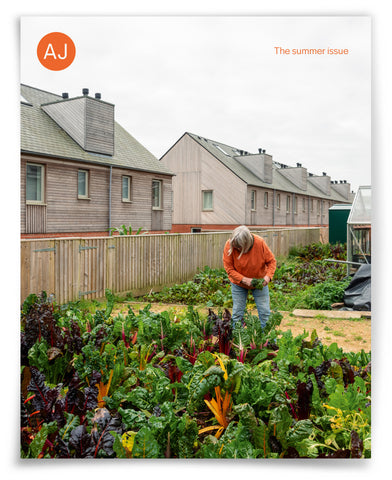
Buildings nestled in burgeoning landscapes, productive gardens providing a community focal point, nature offering sanctuary and solace: the lush abundance of the summer months is on bright display in our July issue.

Four building studies are presented within these pages. For 16 years Barefoot Architects and Bridport Cohousing CLT battled to plan Hazelmead, the largest community housing project in the country. We discover that the effort put in has been rewarded, with the residents feeling a deep connection to their homes, community – and shared vegetable beds.

Feilden Fowles’ work on the Natural History Museum’s formerly underused gardens has created an engaging landscape of outdoor living galleries. The project includes a welcoming garden kitchen and nature activity centre, the latter sporting a sculptural gutter that deposits water into open channels so children can learn about the water cycle.

Our other studies are of Allies and Morrison’s dockside leisure centre and workspace at Canada Water, and FCBS’s Lambeth office block, which has pioneered innovative circular solutions in mass timber construction.

In News, it’s all change at Liverpool Street Station, as original architect Herzog & de Meuron bids to be reappointed to the high-profile job – it’s rumoured that towers on stilts are involved... We also publish all 20 projects receiving RIBA National Awards this year, along with the shortlist for the AJ Retrofit & Reuse Awards.

Elsewhere in the issue, Chris Simmons writes a column on redundancy entitled What to do if you’re chewed up and spat out by architecture, while the Secret Architect is lost in an obstinacy of project managers. And this month we have a bumper Sketchbook section, showcasing the best sketches from attendees at the AJ100 Awards in June.

£16.00


AJ 22.05.25: Out

AJ 22.05.25: Out

Our special edition explores, spotlights and celebrates the LGBTQ+ community’s rich contribution to architecture, providing much affirmation and inspiration: the AJ is going Out.

We present thought-provoking discussions about queer culture, about whose voices are heard, who gets to occupy space – and where. Space is political, and that feels especially so at present. The RCA’s Gem Barton, who leads the Architecture LGBT+ Academic Champions Network, has a striking take: ‘To queer is to disrupt. To queer is to stretch, bend, reimagine and reject inherited structures that no longer serve us — if they ever did.’

Also within the issue are profiles of the community’s champions and leaders, a feature on why we need LGBTQ+ housing, and a deep dive into nightclub design. With Pride month imminent, be sure to fill your calendar using our detailed diary of upcoming events.

In Opinion, Kirsty Watt and Bek Ziola argue that architects have a duty of care to design spaces for all people, regardless of the recent Supreme Court hearing, and David Grandorge undertakes a queer pilgrimage.

The issue also contains two building studies – Feix&Merlin’s restrained refurb of Walworth Town Hall, and John Puttick Associates’ youth centre in a former power station in Blackburn. Plus we revisit a pioneering senior co-housing scheme co-designed by Pollard Thomas Edwards to see what we can learn from this rare and radical way of living.

In Culture, Daniel Ovalle Coastal writes about how his research into LGBTQ+ housing has led him to create dollhouses, and Derin Fadina reviews the queer-focused pavilions at this year’s Venice Architecture Biennale. While in Sketchbook, four architectural professionals share their work made at life drawing sessions.

Elsewhere in the issue you can find our monthly competitions roundup, the full shortlists for this year’s AJ100 awards, and Aga Szedzianis’s column on why interior designers are paid more than architects.

£16.00

AJ 24.04.25: Small Projects

AJ 24.04.25: Small Projects

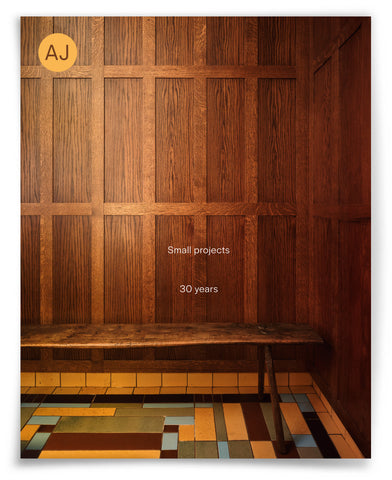
To celebrate the 30th year of AJ Small Projects, we have shortlisted 30 schemes which are showcased in this special issue. Their range and creativity encapsulate what the AJ Small Projects award has always been about: giving well-deserved recognition to projects realised on more modest budgets.

In the issue you’ll discover a home that works with a restricted site and a mature plane tree; a deep retrofit of a cold, leaky 1970s house using natural, local and recycled materials; a pilot project for improvements across an entire block of 153 flats; and a contemporary interpretation of a traditional cottage in the Scottish Highlands.

In addition to the Small Projects shortlist, we also publish a building study on Pollard Thomas Edwards’ landmark development for Haringey Council that mixes homes, healthcare and social purpose, part of the first large-scale social housing programme of its kind in a generation.

Within News, you can read a feature on Part W’s campaign to shine a light on the urban barriers hampering women, and check out the UK’s pavilion at the Osaka World Expo.

In a packed Culture section The Ghost of Ian Nairn, via Ian Martin and Jason Hazeley, expresses his Outrage at today’s London: ‘Look at the Olympic Park: 560 acres of showing off, where there used to be paint shops and railway sidings ... Now what have you got? Basketball, Waitrose and ABBA.’ There is also a review of Dinah Bornat’s new book on child-friendly design, and a write-up of the RIBA’s recent youth event, Festival of the Future.

Rounding out the issue are our editor’s pick of competitions; a column by Kunle Barker on nature; RIBA president Muyiwa Oki on apprenticeships; plus more from David Grandorge, Sketchbook and Hellman.

£16.00


AJ 20.03.25: Natural Materials

AJ 20.03.25: Natural Materials

This month's issue demonstrates how building more with natural materials promotes sustainability, circularity- and joyful architecture.

We highlight three projects with natural materials at their core, including Hugh Strange Architects' House on a Hill; David Kohn Architects' sinuous expansion of one of the University of Oxford's oldest colleges; and a community food market in Ilford designed for disassembly by Clark Architecture and Webb Yates.

For further inspiration, a feature ‘Natural materials on site’ showcases five new projects including a rammed earth house by Tuckey Design Studio and a 'net zero' welcome centre built with straw bales by Citizens Design Bureau.

In News, Richard Waite examines how Lina Ghotmeh beat big-name practices to land the British Museum job, while Martha Dillon uncovers the lessons to be learnt from a new 'biophilic' school. As Biodiversity Net Gain passes its first birthday, Anna Highfield looks at how architects are finding the new legislation and asks: is Labour as committed to nature recovery as the Tories?

In Culture, Ellen Peirson visits SOIL at Somerset House, sharing how the exhibition opens our eyes to the world at our feet. Meanwhile, an interview with Mio Tsuneyama spotlights the radical approaches to domesticity by Japanese architects, challenging Tokyo's 'scrap and build' new homes culture.

Also in the issue, The Coach shares how to find recognition at your new practice, Rory Chisholm shares his sketches, and a work by Hellman, A Monument For A Monarch, closes the issue.

£16.00

AJ 20.02.25: Culture

AJ 20.02.25: Culture

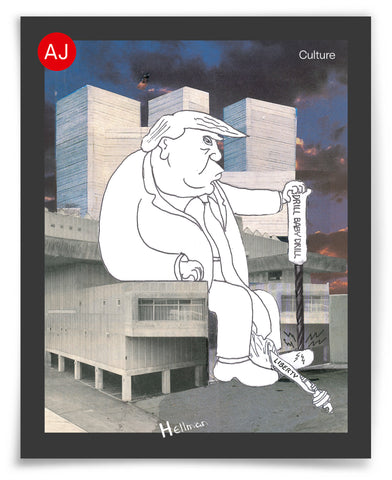
This month’s culture-focused issue contains a review of The Brutalist, which is also the title of Hellman’s cartoon of Donald Trump that appears on the cover. As AJ editor Emily Booth writes, ‘Megalomaniac? Genius? The former property mogul’s cultural impact is already profound.’

We present studies of three cultural projects, including ‘a powerhouse for dance’: O’Donnell + Tuomey’s Sadler’s Wells East. Gianni Botsford’s retreat for creatives on the Isle of Wight, and Reiach and Hall’s museum expansion in western Scotland, are also in the issue. And there is a feature called Exhibitionists, in which we ask a range of practices to tell us how they approach museum and gallery fit-outs, in particular how they prioritise sustainability in their work.

In News, there is a profile of government architects – yes, they do exist – and a feature on infill development – the issues that are holding it back, and some potential solutions. We also share a first look at Niall McLaughlin’s designs for the Maggie’s Centre in Cambridge.

You can read a book review of Protest Architecture by Nick Newman, and there are columns by Hana Loftus (‘a hideous new footbridge underlines the poor state of design standards in the UK’), and Toko Andrews, who argues that architecture shouldn’t be an ‘old man’s game’ anymore.

In Competitions you can find out about the William Sutton Prize, while this month’s sketches are courtesy of Jack Oaten.

£16.00